


Ask Yourself ‘Why?'
- Steve Roberts
- Feb 6
- 4 min read

If we can't identify why we are doing something, it's a sign we should take time to pause and reflect. There's always a reason, even if it becomes obscured or taken for granted.
Why are you doing this?
At first, this might seem like an easy question to answer. But once you dig beneath the surface, it becomes harder to pin down. Often we either take the “why?” for granted or avoid it entirely—moving through routines without pausing to examine what’s really driving us.
Precisely because this question is difficult to answer, it’s worth asking. It applies to almost everything: relationships, career decisions, personal ambitions. Why am I doing this? has a way of interrupting autopilot and bringing us back to what matters, especially when the path starts to feel blurred or forgotten.
I’ve had to ask myself this repeatedly over the past few years in relation to my artistic practice. At times, it has felt like being lost. Yet I’ve learned that the path is often still there—waiting to be noticed again. Becoming obsessed
Around five years ago, I began painting landscapes on a weekly basis, often alongside my friend Colin Clark. We travelled to locations across the Cotswolds and beyond to paint outdoors (en plein air). Those early paintings didn’t always “work”, but we were hooked almost immediately.
For me, it was the feeling of painting in the landscape that kept me returning. Standing on a hillside, doing something I love while being battered by wind or soaked by rain was visceral and invigorating—a way to feel free and fully alive. Whatever the weather or the outcome, I never regretted going.
Over time, that commitment taught me to look harder and sense more. I started to register scale, atmosphere and movement—not just what was in front of me, but how it felt to be there. Gradually, the challenge became how to translate those sensations into paint.
As I grew more confident working quickly and directly, my relationship to the subject shifted. Through repetition, the work became naturally more abstract. I felt an increasing need to express something beyond a literal depiction—using the landscape as a structure for exploring colour, light, atmosphere, movement and change.
This shift wasn’t forced. It came from showing up, paying attention, and letting the work “speak back”. The longer I stayed with it, the clearer it became that I wasn’t simply recording a view—I was responding to lived experience.
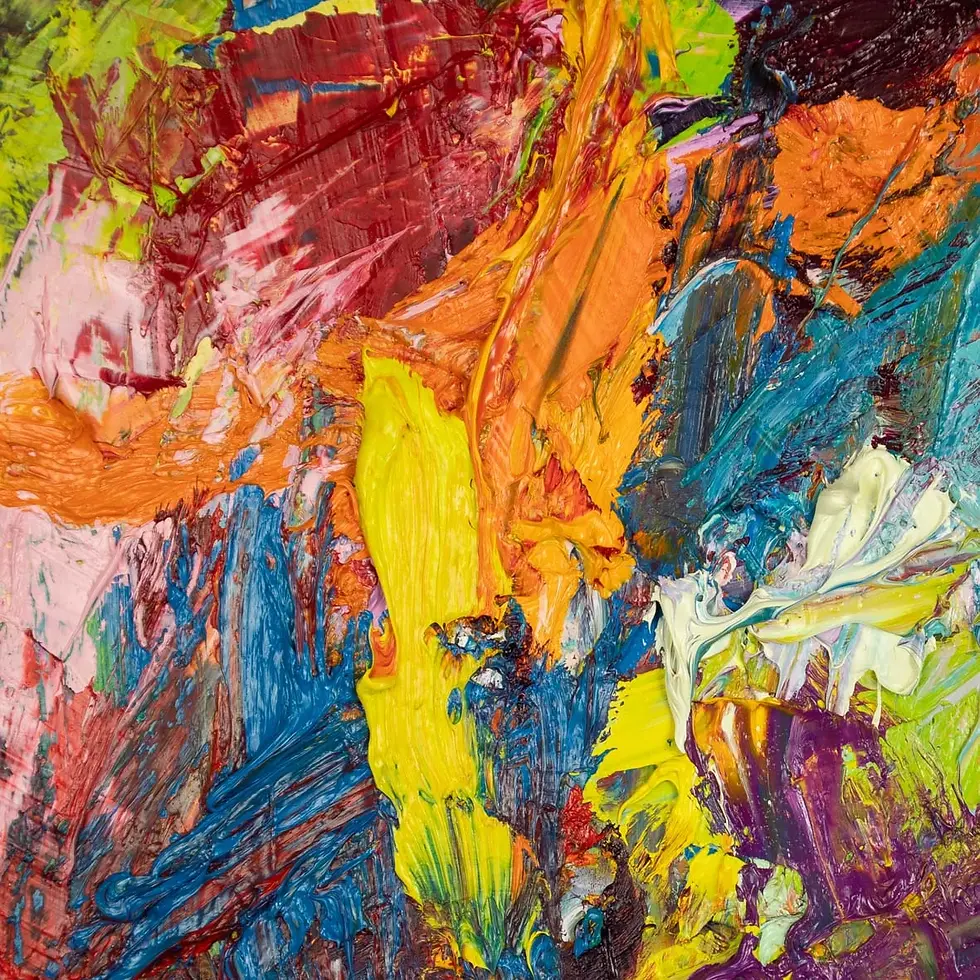
Finding the thread and moving with it regardless of immediate results was the right thing to do for my artistic practice. Though the process can lead to frustration, that difficulty brings understanding about the direction of where to travel.
Moving into full abstraction
That ongoing engagement gradually took me from semi-abstract painting towards full abstraction—something I was slow to recognise as a necessary step. However, frequent conversations with Colin helped enormously to identify this as a path forward for my practice. His Cheltenham studio became a place for critique, honesty and deeper discussion about the motivation and direction of our respective practices.
I began to see that abstraction was what I genuinely wanted to explore, even if it didn’t offer immediate certainty. Committing to this new direction was difficult at first. In the cold light of day, many early paintings felt unresolved. I became distracted by technique—layering, scraping back, painting thickly or thinly—almost as if I were searching for a shortcut.
Looking back, I can see I was trying to find a “solution” rather than properly engaging with the process. When we look outside ourselves for answers that belong to other people, the work often loses its centre. Recognising that isn’t failure—it’s a turning point. It’s an opportunity to return to what feels meaningful, and to trust the direction that is actually ours. When the work resonates more strongly with the artist, it stands a far better chance of resonating with others too—because it carries a sense of necessity rather than imitation.
Oneness: the here and now
At the start of this year, I began a new series of abstract paintings titled Cotswold Rhythm. The method is simple: I would leave the studio and walk in the countryside around it to sketch and take photographs. Back in the studio, I lay out these fragments and spend time with them—allowing them to settle into memory and quietly inform the paintings.
When I first conceived the idea, I assumed the paintings would reflect the walks through recognisable colours or forms. But when I tried to reference those elements too directly, it felt forced. Instead of strengthening the work, it got in the way. Something essential was being obscured, and I needed to reflect on what was really driving the process.
Walking is central to this series because it creates rhythm—through stride and breath. That rhythm brings calm and clarity. My senses sharpen, and I become more open to experience: colour, sound, smell, space, the quality of light, even the pressure of the air.
A shift takes place. Attention moves away from self-conscious thinking and into direct perception. I feel less separated from what’s around me, more engaged in a continual exchange between body, mind and landscape. When I’m sufficiently relaxed, I’m not replaying the past or rehearsing the future—I’m here.
Walking becomes a conduit into that state of presence: a way of noticing interconnection, and of remembering that experience is always moving, always changing.

Painting is a dance not an objective. It cannot be self-conscious or the dance ceases to be meaningful.
Uncovering the why: the continually unfolding present
This engagement with the unfolding present is what draws me to abstraction. Painting without pre-conceived structures (beyond the edges of the surface) requires attentiveness. It asks for responsiveness rather than control.
In that sense, walking and painting feel closely aligned. Both involve moving through uncertainty with intention, listening closely, and adjusting as you go. A painting can’t be forced into existence. You can bring commitment and direction, but outcomes emerge through a conversation with the process itself.
When we become overly focused on results, we lose contact with what’s happening now—the only place we can work from. Asking “why?” has helped me recognise this, and to re-find a path that feels grounded and meaningful. Cotswold Contemporaries
My latest series Cotswold Rhythm will be shown alongside work from Colin Clark and Gerald Crittle at the Cotswold Contemporaries exhibition at: Lower Slaughter Village Hall, 22nd–28th April, 2026. See Colin Clark's Work See Gerald Crittle's Work Exhibition Venue


Comments